Lexias dirtea merguia
(Tytler, 1926)
 |
 |
 |
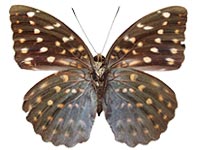 |
|
♂, Ranong, Thailand. |
♀, Ranong, Thailand. |
 |
 |
 |
 |
|
♂, Ranong, Thailand. |
♀, Ranong, Thailand. |
 |
 |
 |
 |
|
♂, Trang, Thailand. |
♀, Nakhon Si Thammarat, Thailand. |
 |
 |
 |
 |
|
♂, Satun, Thailand. |
♀, Trang, Thailand. |
ON :
Adolias intermedia merguia Tytler, 1926
OD : J. Bombay nat. Hist. Soc. 31: 580.
TL : "Mergui" [Myeik, Myeik Dist., Myanmar]. (NHML)
Distribution : S.Myanmar, P.Thailand (south of Phetchaburi), Langkawi, W.Malaysia.
|
● ssp.bontouxi |
|
● ssp. (unclear) |
|
● ssp.01 |
|
● ssp.02 |
|
● ssp.merguia |
|
 |
Synonym
Lexias dirtea pluvius Tsukada, 1991; In: Tsukada, Butterflies of the South East Asian Islands 5: 385, 547, pl.81, figs.6(PT,♀), 8(PT,♂Un), 9(HT,♂); TL: Ranong, S.Thailand.
Type Materials Information
pluvius :
Holotype ♂, Mar.1990, Ranong, S.Thailand. (in coll. E. Tsukada)
Paratypes : 2♂, Mar.1990, Ranong, S.Thailand. ; 1♀, Apr.1990, Muang Chone, S.Thailand.
Records taken from Literature
[ THAILAND ]
Adolias dirtea dirtea: Pendlebury,1923 : 41. (Nakhon Sri Thammarat: Khao Ram; Khao Luang)
Adolias dirtea dirtea: Godfrey,1930 : 296. (Nakhon Sri Thammarat: Khao Ram; Khao Luang; Wat Kiriwong)
Adolias dirtea dirtea: Godfrey,1932a : 270. (P)
Euthalia dirtea merguia: Pinratana,1979 : 84, figs.N147,♂,♀. (Ranong; Trang; Yala)
Lexias dirtea merguia: Pinratana & Eliot,1996 : 83, pl.58, figs.158a♂,♀. (Ranong; Nakhon Sri Thammarat; Trang) (partim)
Lexias dirtea merguia: RDPB & DNP,2006–2008 : Butterflies in Hala-Bala Forest, fig.♂. (Narathiwat: Hala Bala) (last update: 2006.12.27 ; accessed: 2024.05.11)
Lexias dirtea merguia: RDPB & DNP,2006–2008 : Butterflies in Hala-Bala Forest, fig.♀. (Narathiwat: Hala Bala) (last update: 2006.12.27 ; accessed: 2024.05.11)
Lexias dirtea merguia: Ek-Amnuay,[2007] : 458, pl.203, figs.N167b♂,♂(Un),♀. (Ranong: Kampuan) (partim)
Lexias dirtea merguia: Les Day,2011–2022 : Samui Butterflies, figs.♂,♀. (Koh Samui) (accessed: 2022.03.24)
Lexias dirtea merguia: Ek-Amnuay,2012 : 468, pl.208, figs.N333b♂,♂(Un),♀,♀(Un). (Ranong) (partim)
Lexias dirtea merguia: Kimura et al.,2016 : 114, figs.♂,♂(Un),♂,♂(Un),♀,♀(Un),♀,♀(Un). (Muang Shone; Kam Puan; Khlong Naka; Kao Luang; Ka Chong; Than To WF.) (partim)
Lexias dirtea merguia: Küppers & Janikorn,2020 : 71, figs.Abb.N-443–447. (Phang Nga)
Lexias dirtea merguia: Yokochi,2026 : 13, map.1. (Peninsular Thailand)
Lexias dirtea merguia: Sophonviwatkul et al.,2023– : Butterflies of Thailand, fig. (Phetchaburi; Yala) (accessed: 2026.08.25)
Specimens Examined
[ THAILAND ]
Phetchaburi : 1♀ (photo by M.Hayashi).
| Jan | Feb | Mar | Apr | May | Jun |
Jul | Aug | Sep | Oct | Nov | Dec |
Ranong : 7♂ 4♀.
| Jan | Feb | Mar | Apr | May | Jun |
Jul | Aug | Sep | Oct | Nov | Dec |
Nakhon Sri Thammarat : 1♂ 1♀.
| Jan | Feb | Mar | Apr | May | Jun |
Jul | Aug | Sep | Oct | Nov | Dec |
Trang : 3♂ 1♀.
| Jan | Feb | Mar | Apr | May | Jun |
Jul | Aug | Sep | Oct | Nov | Dec |
Satun : 2♂ 1♀.
| Jan | Feb | Mar | Apr | May | Jun |
Jul | Aug | Sep | Oct | Nov | Dec |
Yala : 1♂.
| Jan | Feb | Mar | Apr | May | Jun |
Jul | Aug | Sep | Oct | Nov | Dec |
Notes
The butterfly is common in forests at low to moderate elevations (10–900 m a.s.l.) and frequently comes to rotten fruits that have fallen to the ground.
Males from the populations in Ranong to Nakhon Si Thammarat tend to be larger than those of other populations, as noted by Tsukada (1991); however, this character is highly variable and inconsistent.
Usually, Lexias pardalis and Lexias dirtea can be distinguished by the colouration of the antennal tips.
L. dirtea has entirely black antennal tips, whereas in L. pardalis, yellow to orange colouration extends from the tip to approximately the fifth segment.
However, in areas where the two species occur sympatrically, individuals with very dark, orangish-black antennal tips are frequently observed.
The orangish colouration may be difficult to discern unless the specimen is viewed from a different angle.
Consequently, these individuals cannot be reliably distinguished on the basis of antennal colouration alone.
Further molecular analysis is required to determine whether these individuals represent intraspecific variation or interspecific hybridisation.
As noted by Kimura et al. (2016), the wing patterns of L. dirtea and L. pardalis are considered to exhibit parallel geographic variation across their respective ranges.
Literature
Tytler, H, 1926. Notes on some new and interesting butterflies from India and Burma. Part II.
Journal of the Bombay natural History Society, 31(3): 579–590, 3 pls.
Tsukada, E, 1991. In: Tsukada, E. (Ed.), Butterflies of the South East Asian Islands 5. Nymphalidae (II).
Azumino Butterflie's Research Institute, Nagano, 576 pp., (238 pls.). (in Japanese)
Eliot, J.N. & Kirton, L.G, 2000. Revisional notes and nomenclatural changes of some Peninsular Malaysian butterflies.
Malayan Nature Journal, 54(2): 131–145.
Abe, A. & Kumagai, Y, 2010. A study of chromosomes in four species of Lexias (Lepidoptera, Nymphalidae).
Tyô to Ga, 61(1): 79–86. (in Japanese)
Yokochi, T, 2026. Taxonomic reassessment of Lexias dirtea (Fabricius, 1793) and Lexias pardalis (Moore, 1878) (Nymphalidae: Adoliadini) based on type material and nomenclatural history.
AIRS Journal of Entomology, 1(1): 1–22.
 |
 |
| ♂, Yala, Thailand. |
♀, Phetchaburi, Thailand. (photo by M.Hayashi) |
A Check list of Butterflies in Indo-China, Chiefly from THAILAND, LAOS & VIETNAM. Copyright © 1996- Y.Inayoshi.


